


Azores
The Azores islands are not just a destination but a magical journey. At the core of our nine islands you will find a harmonious convergence of majestic scenery with the human warmth and way of life that is both timeless and contemporary. Over the years the Azores Islands have gained the trust of visitors longing for a holiday that is both safe and exciting yet peaceful. Start your journey with Azores.com, the top destination site for information travel reservations and real estate on the Internet. You'll love our service.


Flag of the Azores
The flag of the Azores is similar to the flag of Portugal used from 1830-1910, except that the Portuguese coat of arms has been removed and been replaced by the Goshawk (in Portuguese: Açor), the symbol of the Azores.
Colours
Blue and white have always been the traditional colours of the Portuguese Nation, first present in the coat of arms of Henry, Count of Portugal. During the height of the Portuguese Civil War, in the early 19th century, the Azores served as an important Liberal stronghold, with the prominent Duke of Terceira struggling against the absolutists led by Dom Miguel. The colours of the flag were thusly adopted from the Portuguese liberal flag, as to demonstrate the Azores' important role in the establishment of a constitutional monarchy in Portugal.
It should be relevant to remark that the current flag of the Azores was mostly based on the flag first employed by the Azores Liberation Front, a right-wing independentist movement which appeared after the Carnation Revolution, out of the fear of Portugal becoming a Soviet puppet-state. According to the organisation, blue and white stood for Portuguese classical liberalism, as opposed to the "totalitarian socialist forces" that would dominate the country in the mid-70's.
It should be relevant to remark that the current flag of the Azores was mostly based on the flag first employed by the Azores Liberation Front, a right-wing independentist movement which appeared after the Carnation Revolution, out of the fear of Portugal becoming a Soviet puppet-state. According to the organisation, blue and white stood for Portuguese classical liberalism, as opposed to the "totalitarian socialist forces" that would dominate the country in the mid-70's.
Symbolism
The name of the archipelago comes from the Portuguese word açor, meaning goshawk, because it was supposed to be a common bird at the time of the discovery. However these birds never existed on the islands, they actually were a local subspecies of the buzzard (Buteo buteo), that was erroneously identified as goshawks by the first explorers. The eagle on the flag is intended to be the celebration of that historical mistake. The nine stars stand for the nine islands of the archipelago, while the Portuguese lesser arms are present in the top left corner of the flag.

Disembark in S. Miguel and begin your visit in the largest city of the Azores, Ponta Delgada, where there is excellent accommodation able to ensure your stay includes every comfort and quality.Ponta Delgada, first settled by fishermen attracted by its safe port, soon began to take over as the island’s main port. It is now a dynamic and cosmopolitan city with a highly active outwardly looking cultural scene. The long road running round the port defines the city’s profile. Walk this coast road and experience its changing nature. Throughout the day, there is a constant stream of those going about their daily activities that, as the evening draws on, gives way, and especially in the summer months, to those of more recreational intent. This amply represents Ponta Delgada’s dynamism and adaptation to modern times while its accesses display the historical marks left by five centuries of history, precious testament to times gone by.


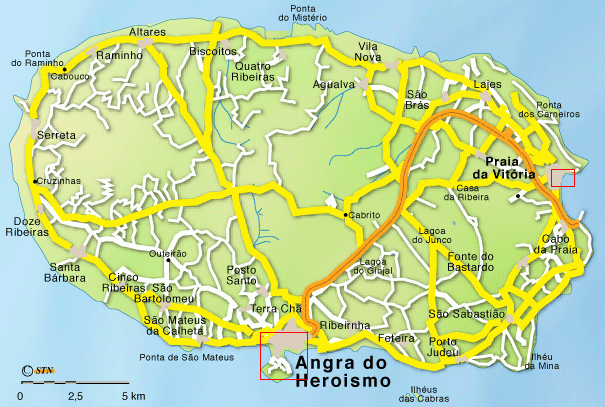
Terceira Island is an island in the Azores, in the middle of the North Atlantic Ocean, with an area of 396.75 km². The island's length is 29 km and the width is 18km; the perimeter is 90 km. Population is 54,996, down from a peak of 59,000. Population density is 140.73/km².
Terceira Island consists of four overlapping stratovolcanoes built above a fissure zone, which rise from a depth of over 1,500 metres (5,000 ft) on the floor of the Atlantic Ocean. The oldest at over 300,000 years is the Cinquo Picos stratovolcano that forms the eastern part of the island, with a 7 km (4 mi) diameter caldera which is one of the largest in the Azores. Next in age at perhaps 100,000 years is the Guilherme Moniz stratovolcano in the south-central part of the island, which also has a caldera with the highest remaining point on the rim reaching 623 metres (2,044 ft). Just to its north is the Pico Alto stratovolcano, probably less than 60,000 years old. It once had a caldera too, but subsequent eruptions filled it with several smaller lava domes and cones which top out at 808 m (2,651 ft).


The island of Santa Maria is an island located in the southeastern part of the Azores and is the southernmost island in the Azores Islands. It was the first island in the Azores Archipelago to be discovered. The discoverer of the island was Diogo Silves during his journey to Madeira in 1427. Gonçalo Velho brought families and cattle to the island.
The area of the island is 97.18 km². The island contains one municipality named Vila do Porto that has the oldest Azorean villages. The island also has old houses with windows that belonged to Capitão Donatário, dating back to the 15th century.
Due to its geological age (the island was formed 4.8 million years ago), Santa Maria is the only island in the Azores with an abundance of sediments. It is in these sediments that marine fossils have been discovered.
The houses are spread all across the island. Alentejana houses generally have large chimneys. The land is very fertile and the rural landscape has great beauty.


São Jorge also known in English as San Jorge) is an island in the central part of the Azores. It is separated from Pico Island by 15 km with a strait. Its east to west length is 53 km and its north to south width is 8 km. The area is 237.59 km² and the population is 10,500.
It was first discovered in 1439. The island wasn't populated until twenty years later when colonists came from the provinces of the northern part of Europe. São Jorge is a volcanic island, as are many of the Azorean islands. It has erupted six times between 1580 and 1907. Ten people were killed by the 1580 eruption and eight in 1808. In both eruptions small glowing clouds were reported. A possible submarine eruption was reported southwest of the island in 1964 but was not confirmed.
The highest point is Pico da Esperança at 1,053 meters. The island's agriculture includes cattle, cereals, and fruits. Other main industries include fisheries and dairy products.
Administratively, São Jorge is divided into two municipalities (concelhos), Calheta in the east with five parishes and Velas in the west with six parishes.
Subscrever:
Mensagens (Atom)


